Case Study
The Philippines faces a sovereignty crisis in the West Philippine Sea, where Chinese vessels extract an estimated $1.5 billion worth of marine resources annually while threatening 1.6 million Filipino fishermen's livelihoods. Coast Guard patrols cover less than 3% of territorial waters, vessels disable AIS transponders at will, and satellites provide only periodic snapshots—not the continuous intelligence needed to protect sovereignty.

The Challenge:
Traditional monitoring systems existed in isolation—AIS showed vessel positions, satellites provided imagery—but couldn't reveal crew-level behavior, operational patterns, or validate vessel identity against actual signal signatures. Critical questions remained unanswered: Which vessels actually operate in territorial waters? How frequently do they return? Are the same crews involved? Where should limited enforcement resources focus?
The Outcome:
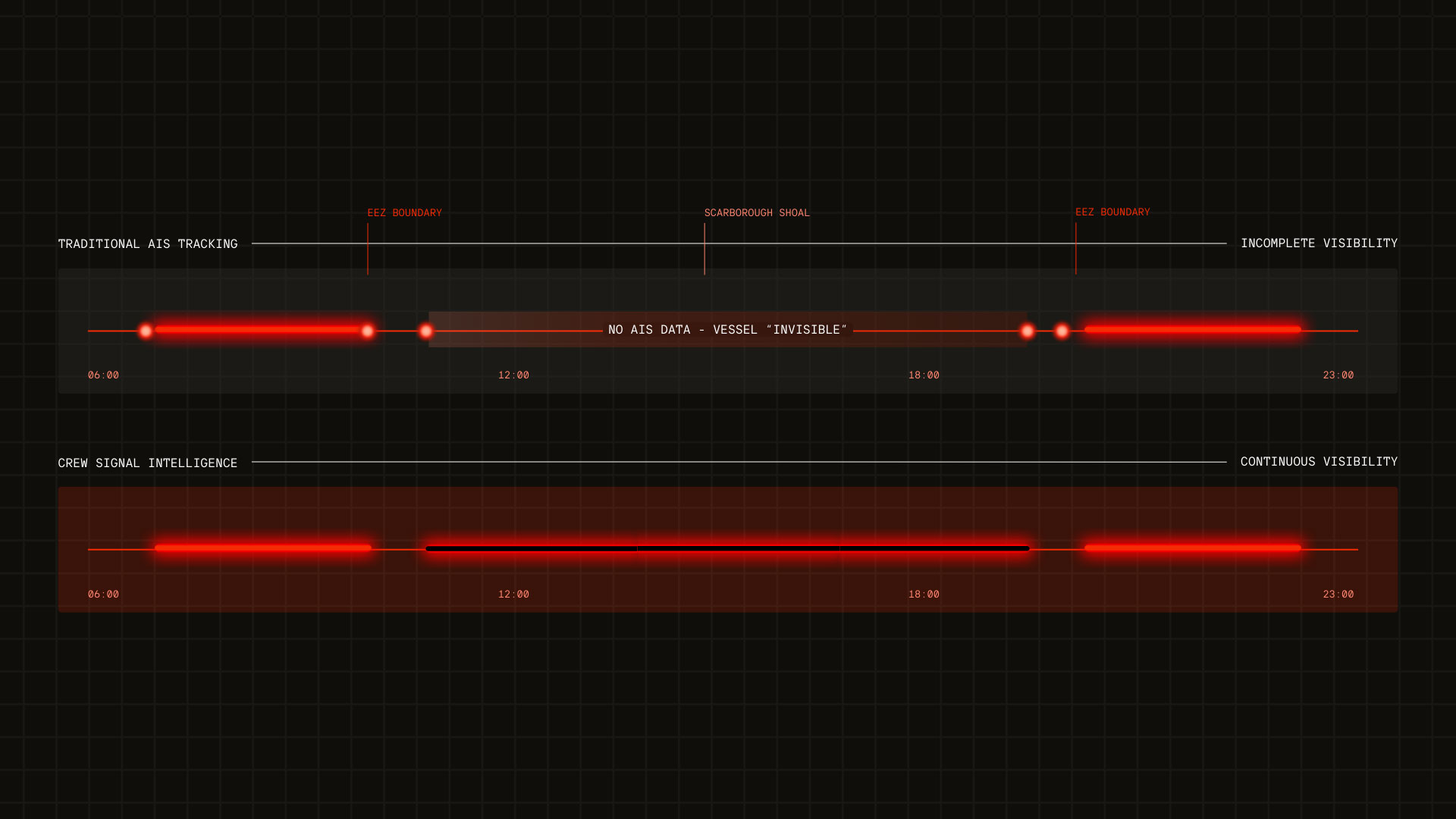
Mobile signal intelligence unified fragmented data across critical zones into a single convergence layer, revealing behavioral anomalies the moment they emerge. The platform exposed systematic evasion tactics invisible to traditional monitoring—vessels disabled AIS at EEZ boundaries, operated dark for 8-14 hours, then re-enabled when departing. Crew-level tracking identified repeat offenders across multiple vessels and dozens of illegal incursions, shifting enforcement from intercepting random vessels to disrupting systematic operations. Pattern analysis revealed the majority of incursions occurred during new moon periods, enabling predictive deployment that increased interdiction rates while reducing fuel costs. Maritime enforcement transformed from monitoring vessel positions to understanding the human behavior behind sovereignty violations—regardless of evasion tactics.